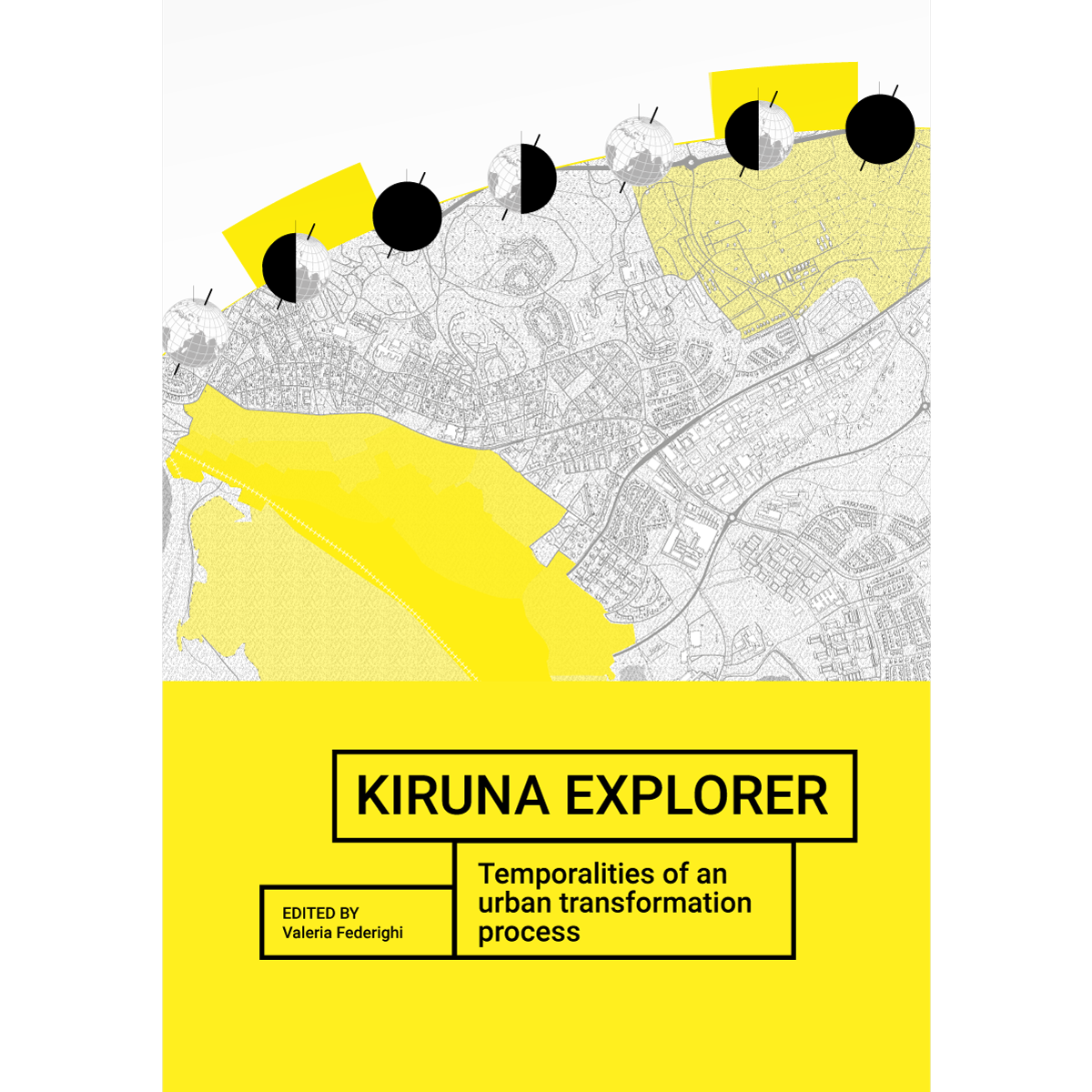
KIRUNA EXPLORER
Temporalities of an Urban Transformation Process
Edited by Valeria Federighi
Kiruna, Sweden’s northernmost city, is undergoing one of Europe’s most radical urban transformations. Ground deformation caused by the expansion of the world’s largest underground iron ore mine is forcing large parts of the existing city to be abandoned, demolished or relocated. Buildings are moved, neighbourhoods disappear, new urban structures are created and questions of architectural heritage, identity and landscape have to be renegotiated.
Kiruna Explorer examines this extraordinary process from the perspective of architecture, urban design and planning. Rather than presenting the relocation of Kiruna as a single planning project, the book investigates the different time scales that shape urban transformation: long-term political and planning decisions, immediate physical changes to the built environment, and the moments in which architects, planners, institutions and citizens can actively influence future development.
The book is structured around three complementary approaches: diachronic, synchronic and opportune. Diagramming is used to trace decisions, actors and documents over time; mapping connects these processes to their physical consequences in the city and territory; and digital tools explore how complex information can support future decision-making.
A particular focus lies on the relationship between planning and the material city. The maps examine how predicted ground deformation intersects with the existing urban fabric, compare scenarios for the location and design of the new city, and document the processes of demolition, relocation and reconstruction that are reshaping Kiruna.
For architects and urban planners, Kiruna therefore becomes more than an exceptional case study. It raises fundamental questions about how cities can be designed when the ground itself is unstable, how architectural heritage can be preserved when buildings must move, and how planning can respond to economic, environmental and social forces that develop at very different speeds.
Combining architectural research, cartography, diagrams, fieldwork, voices from Kiruna and digital methods, Kiruna Explorer provides both an analytical framework and a practical research tool for understanding urban transformation while it is still taking place. The project itself is ongoing and extends towards Kiruna’s development in the context of European Capital of Culture 2029.
“What is hidden within political and economic interests, bureaucratic decisions and extractivist practices rarely manifests so clearly on the surface, becoming as symbolically and politically visible as it does in the case of Kiruna. This book and project are much more than an architectural-forensic account of a symbolic Anthropocene event; they operate as a real-time intervention: a tool for critical examination, sensing transformation, and mapping complexity while it is still unfolding. Essential reading for all of us who, in this age of planetary-scale uncertainty and anxiety, want to deep-dive and search for clues and answers within the complexity and multidimensionality of Anthropocene madness.”
Vladan Joler, co-author of Calculating Empires: A Genealogy of Technology and Power Since 1500; Silver Lion, Biennale Architettura di Venezia 2025
ISBN: 978-3-88778-148-4, English, Author: Valeria Federighi, 184 Pages