
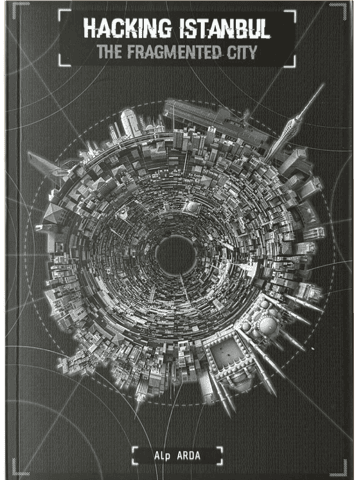
How can we understand a city that has grown through centuries of migration, political change, informal development, economic pressure and constant transformation?
In Hacking Istanbul, architect Alp Arda approaches Istanbul as a complex living system. Rather than seeing the city as a unified whole, he examines it as a fragmented urban landscape shaped by architecture, infrastructure, politics, social networks, economic forces and seismic risk. Istanbul becomes a city that can be “decoded” – almost like a program whose hidden rules and structures can be uncovered and reconsidered.
The book traces Istanbul’s transformation from post-war migration and the growth of informal gecekondu settlements to mass housing, global investment and today’s rapidly changing metropolis. Particular attention is given to Kartal, a former industrial district that serves as a “backdoor” through which the mechanisms and contradictions of the wider city can be explored.
Based on months of field research, interviews, historical sources, GIS data, maps, photographs and architectural drawings, the study combines theoretical analysis with direct observation of urban life.
Arda introduces the architect as an urban/archi-hacker: someone who does not simply design buildings, but reads the city, identifies its underlying codes and asks how they might be rewritten. The book develops this approach through the stages of De-Code, En-Code and Re-Code, moving from an analysis of the existing city towards alternative possibilities for its future.
Hacking Istanbul is therefore more than a study of one metropolis. It offers a new way of thinking about contemporary cities as complex, fragmented and continuously evolving systems – and about the role architecture can play in understanding and shaping them.
ISBN: 978-3-88778-415-4, 304 Pages, Format: 17 × 24 cm, Binding: Softcover with flaps, Language: English
Rezensionen
Es gibt noch keine Rezensionen.